
Ever driven toward an airport and thought, “Wait, is that horse… glaring at me?” At Denver International Airport, you’re not imagining it. A 32-foot blue mustang with glowing red eyes greets travelers on the way in, and a piece of the unfinished sculpture actually killed its creator.
Inside, murals show a gas-masked soldier, frightened children, and scenes of destruction. Beneath it all runs an extensive network of tunnels. That’s quite a collection for a place where most people just want to catch a flight.
Table of Contents
As a Denver-area local, I’ve passed through DIA plenty of times, before, during, and after its recent renovations. I’ve seen its unusual artwork firsthand and heard more than a few rumors about what might be hiding beneath it. And after all these years, the place still fascinates me.
And honestly? I get why the stories caught on. The airport opened more than a year late, cost billions, and sits on a massive stretch of land far from downtown. Throw in a Masonic dedication stone and a few tunnels, and you’ve practically written the conspiracy theories yourself.
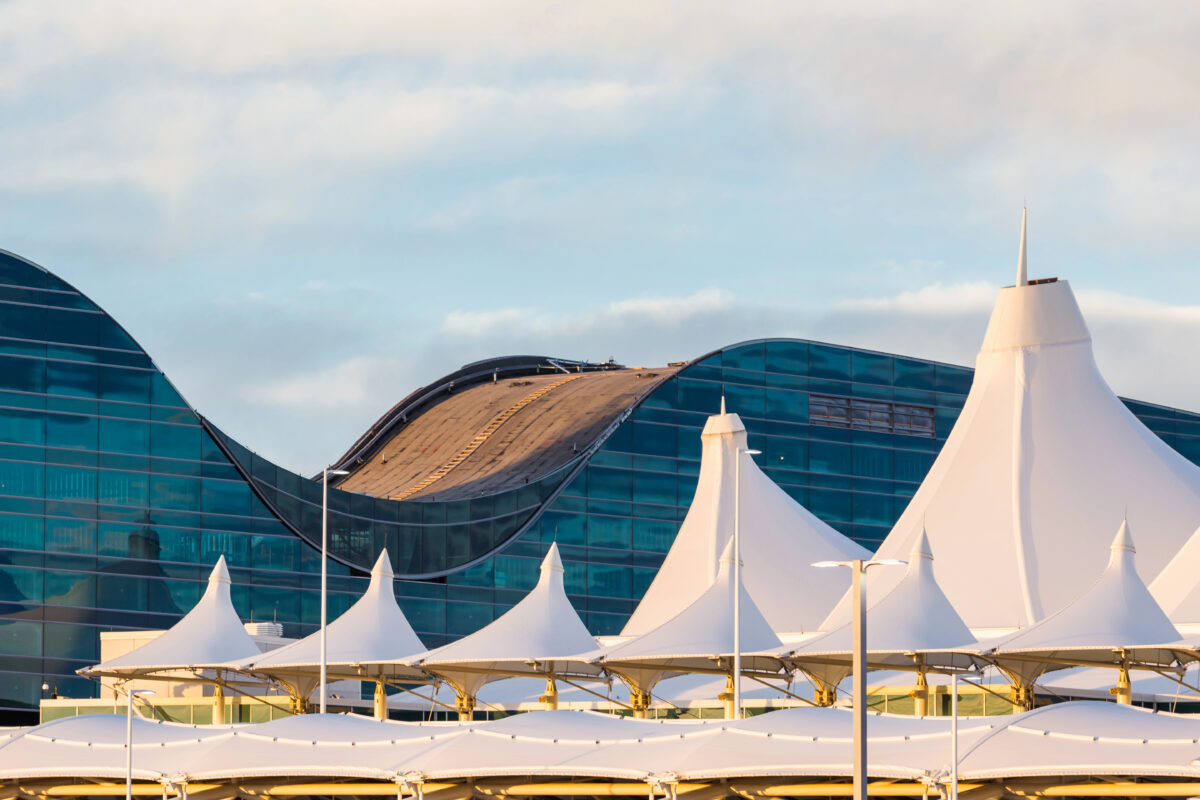
Why Is Denver International Airport So Big and So Far From Denver?
Denver International Airport (DIA) sits about 25 miles northeast of downtown Denver, surrounded by miles of open prairie. At 53 square miles (roughly 34,000 acres), it’s the largest airport in the United States by land area and more than twice the size of Manhattan.
That’s an enormous amount of space for an airport, especially one that replaced a much smaller facility closer to the city.
Before DIA opened, Denver relied on Stapleton International Airport, just a few miles from downtown. By the 1980s, Stapleton was struggling with crowded facilities, flight delays, noise complaints, and little room to expand.
City leaders decided to start fresh rather than keep squeezing more flights into an airport that had outgrown its location. The new site offered room for widely spaced runways, future expansion, and fewer conflicts with nearby neighborhoods.
After years of planning and construction, DIA finally opened on February 28, 1995. Its enormous size and remote location had practical explanations, but the troubled construction project gave people plenty of other reasons to wonder what was happening behind the scenes.
The Real Stories Behind Denver Airport’s Strangest Conspiracies
From a sculpture with a tragic history to underground tunnels and artwork that looks downright apocalyptic, DIA has plenty of unusual features. Here’s what sparked the rumors and what the evidence actually tells us.
1. The Giant Blue Horse That Killed Its Creator
If you’ve driven along Peña Boulevard toward Denver International Airport, you’ve probably spotted the enormous blue horse rearing up beside the road. Standing 32 feet tall, weighing around 9,000 pounds, and sporting glowing red eyes, it’s not exactly a comforting welcome to Denver.
Its official name is Mustang, but locals have given it a much more memorable nickname: Blucifer.
Luis Jiménez, a celebrated New Mexico artist, created the sculpture. Known for his enormous, brightly colored works, Jiménez often drew inspiration from the people, animals, and cultures of the American West.
Denver commissioned the sculpture in 1992, but the project ran into trouble almost immediately. Jiménez missed multiple deadlines, and the city eventually sued him over the delays. What began as an ambitious public art project turned into a lengthy legal dispute.
On June 13, 2006, the project took a tragic turn.
While Jiménez worked on the unfinished horse at his studio in Hondo, New Mexico, a large section fell from a hoist and pinned him. The accident severed an artery in his leg and killed the 65-year-old artist.
His family helped finish the sculpture, and Denver International Airport installed Blucifer in 2008.
The accident added another unsettling chapter to the horse’s history. People began calling it cursed or possessed, while others linked it to the sinister forces they believed operated beneath the airport.
But the sculpture’s unusual appearance has a much more personal history.
Jiménez drew inspiration from his own horse, Black Jack, a blue roan Appaloosa. The glowing red eyes were a tribute to his father, who ran a neon sign shop where Jiménez learned skills that shaped his artistic career.
His dramatic sculptures celebrated the people, animals, and cultures of the American West. Mustang was one of his final works, and his family saw it through to completion.
Behind Blucifer’s sinister nickname and stories of a curse is the final artistic legacy of a man who never got to see his enormous horse standing outside Denver’s airport.
2. The Airport Murals That Look Like Scenes From the Apocalypse
A soldier wearing a gas mask. Frightened children surrounded by rubble. Dead animals, burning forests, and three girls lying in coffins.
These disturbing scenes appeared in two enormous murals created for Denver International Airport when it opened in 1995. And for decades, they’ve fueled some of the airport’s wildest conspiracy theories.
Colorado artist Leo Tanguma painted Children of the World Dream of Peace and In Peace and Harmony with Nature as part of DIA’s original public art collection.
In Children of the World Dream of Peace, a menacing soldier towers over scenes of war and suffering. In In Peace and Harmony with Nature, children mourn dead animals and environmental destruction.
Some viewers interpreted the imagery as predictions of genocide, biological warfare, or a coming New World Order. Others believed the airport was displaying a secret plan for humanity’s future in plain sight.
Those interpretations ignore the rest of the paintings.
Both murals move from destruction toward hope. Children from different nations overcome the threatening soldier and celebrate peace, while other scenes show the natural world recovering from environmental devastation.
Tanguma, whose work often addresses social injustice, war, and environmental destruction, created the murals to warn about the harm people inflict on one another and the planet.
Watch: The Real Story Behind DIA’s Mysterious Murals
In this Rocky Mountain PBS report, Tanguma explained that he wanted his murals to show both the problems in society and the beauty and hope that still exist.
He has also spoken out about how conspiracy theorists twisted his artwork, turning messages about peace and environmental protection into supposed evidence of the very disasters he was condemning.
The murals sparked fresh speculation in 2018 when the airport removed them from public view during its Great Hall renovations. Some people claimed officials were hiding the paintings because their secret meaning had come to light.
In reality, construction crews needed the space, so the airport placed the paintings in storage during renovations.
The airport returned In Peace and Harmony with Nature to public display on Level 5 of the Great Hall in August 2026. Officials expect to reinstall Children of the World Dream of Peace in early 2028.
Understandably, these images would catch travelers off guard. War, death, and environmental devastation aren’t exactly what you’d expect to see between baggage claim and the security checkpoint.
But the murals aren’t celebrating destruction. They’re warning against it. And the hopeful scenes that complete each painting are essential to understanding what the artist was trying to say.
3. There Really Are Underground Tunnels Beneath Denver Airport
Of all the strange stories about Denver International Airport, the underground tunnels might be the easiest to believe. That’s because they actually exist, and some have sat largely unused for decades.
Beneath the terminal and concourses is a sprawling network of tunnels used to move passengers, baggage, equipment, and airport workers. Travelers experience part of this underground world when they ride the train between concourses, but most of it remains out of public view.
When Denverite reporters toured the tunnels in June 2026, they found a busy underground operation. Baggage vehicles traveled along dimly lit roads, workers moved through noisy industrial spaces, and the network was large enough to have intersections with actual stop signs.
They also photographed remnants of the airport’s abandoned automated baggage system, machinery left behind by one of DIA’s most expensive engineering failures.
Much of this infrastructure dates back to DIA’s original automated baggage system, an ambitious project the airport eventually abandoned after years of technical problems. Some of the equipment remains underground, offering a glimpse into one of the most notorious failures in the airport’s history.
That gave conspiracy theorists plenty to work with.
Rumors spread about entire buildings buried beneath the airport, secret military installations, and massive bunkers designed to shelter powerful people during a catastrophe. Some theories even claimed the tunnels connected to distant government facilities.
But the documented underground spaces serve ordinary airport operations, and reporters have been allowed inside to see them firsthand. There’s no credible evidence that the tunnels conceal an underground city or a secret government headquarters.
Watch: Local News Goes Beneath Denver Airport
A local news crew was given access to DIA’s underground facilities, where employees even played along with the reptilian conspiracy theories. The footage offers a rare look at the real spaces that have inspired decades of speculation.
And here’s an unexpected twist: Some of the tunnels that fueled decades of conspiracy theories could soon become public walkways.
In May 2026, airport officials announced plans to convert portions of the old baggage tunnels into pedestrian walkways connecting Concourses A, B, and C. The project would give passengers an alternative to the underground train, which is currently the only way to reach Concourses B and C.
Construction is expected to begin in 2027.
After decades of speculation about what might be hiding beneath DIA, some of its most mysterious underground spaces could eventually become something surprisingly ordinary: hallways filled with travelers rushing to catch their flights.
4. The $4.8 Billion Question: What Went Wrong During Construction?
Denver International Airport was supposed to be a modern marvel. Instead, it became a costly construction nightmare, opening 16 months late and costing more than $4.8 billion.
And one of the biggest problems wasn’t hidden underground. It was luggage.
When Denver began building its new airport, officials envisioned a revolutionary automated baggage system that would whisk suitcases through miles of underground tracks using computer-controlled carts. The technology was supposed to move bags quickly and efficiently, reducing the need for traditional baggage handlers.
During testing, carts collided, luggage was crushed or misrouted, and bags sometimes went flying off the tracks. The failures were so dramatic that footage of the malfunctioning system became a national embarrassment.
The problems weren’t limited to a few broken suitcases. Software failures, mechanical defects, and major design changes made the system increasingly difficult to complete.
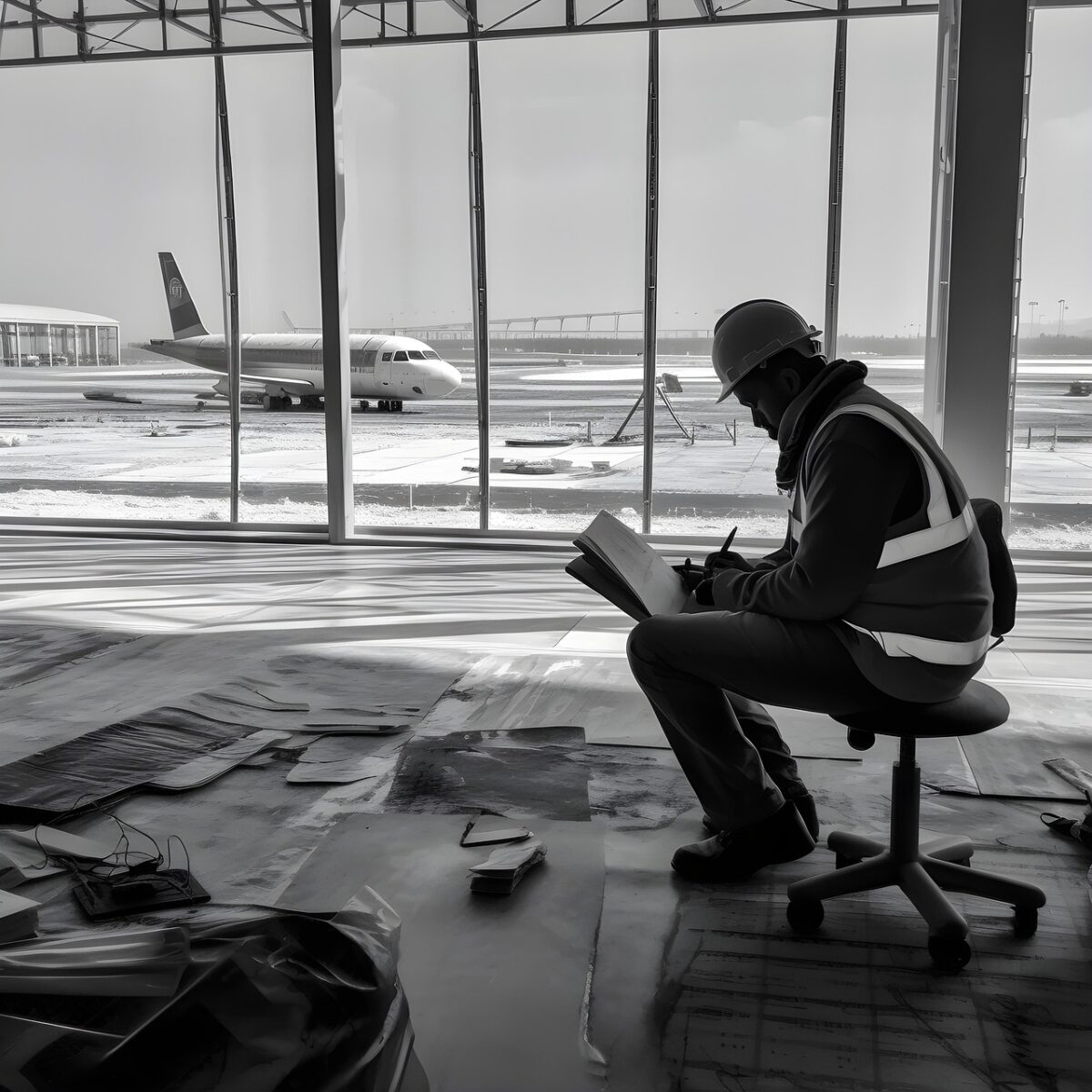
According to the U.S. Government Accountability Office (GAO), the baggage system’s estimated cost climbed from approximately $195 million to more than $290 million. Its failures contributed to repeated delays, pushing the airport’s opening from October 1993 to February 28, 1995.
Every additional month brought more expenses. A 1994 GAO report estimated that the delayed opening could cost approximately $360 million.
And that was just part of a much larger financial picture.
By the time DIA opened, its total cost exceeded $4.8 billion, including construction, land, financing, and other associated expenses. Federal investigators documented substantial increases over earlier estimates, along with questions about airport financing and disclosures to bondholders.
The project was financed largely through airport revenue bonds, supported by airport-generated income, along with federal funding and other sources. So it isn’t accurate to say that taxpayers paid the entire bill. But the enormous costs, delayed opening, and financial risks were real.
The automated baggage system never fulfilled its original promise. Only a limited portion operated when DIA opened, and the airport eventually abandoned the technology for more conventional baggage handling.
It’s easy to see how delays, rising costs, and extensive underground construction fueled rumors about secret facilities. When an airport opens 16 months late with construction costs far above early estimates, people start looking for explanations.
But the documented story raises enough questions without inventing an underground headquarters for the New World Order. Denver invested heavily in an ambitious technology that wasn’t ready, struggled to make it work, and paid a substantial price for the delays.
That’s a real construction failure, and one worth examining on its own merits.
5. The Masonic Stone, the Time Capsule, and the New World Airport Commission
Inside Denver International Airport, a granite dedication stone bears the Freemasons’ square-and-compass symbol, the names of two Masonic grand lodges, and a reference to something called the New World Airport Commission.
Dated March 19, 1994, the stone also marks a time capsule intended for future Coloradans to open in 2094.
Naturally, the unusual combination has inspired plenty of theories about the Illuminati, secret societies, and a supposed New World Order.
But the Masonic connection was never a secret. Colorado Freemasons participated in the airport’s dedication ceremony, following a centuries-old tradition of laying cornerstones for public buildings. George Washington even participated in a Masonic ceremony for the U.S. Capitol’s cornerstone in 1793.
The organization’s mysterious reputation often overshadows its actual traditions. Our look at what Freemasons do at their meetings offers a closer look.
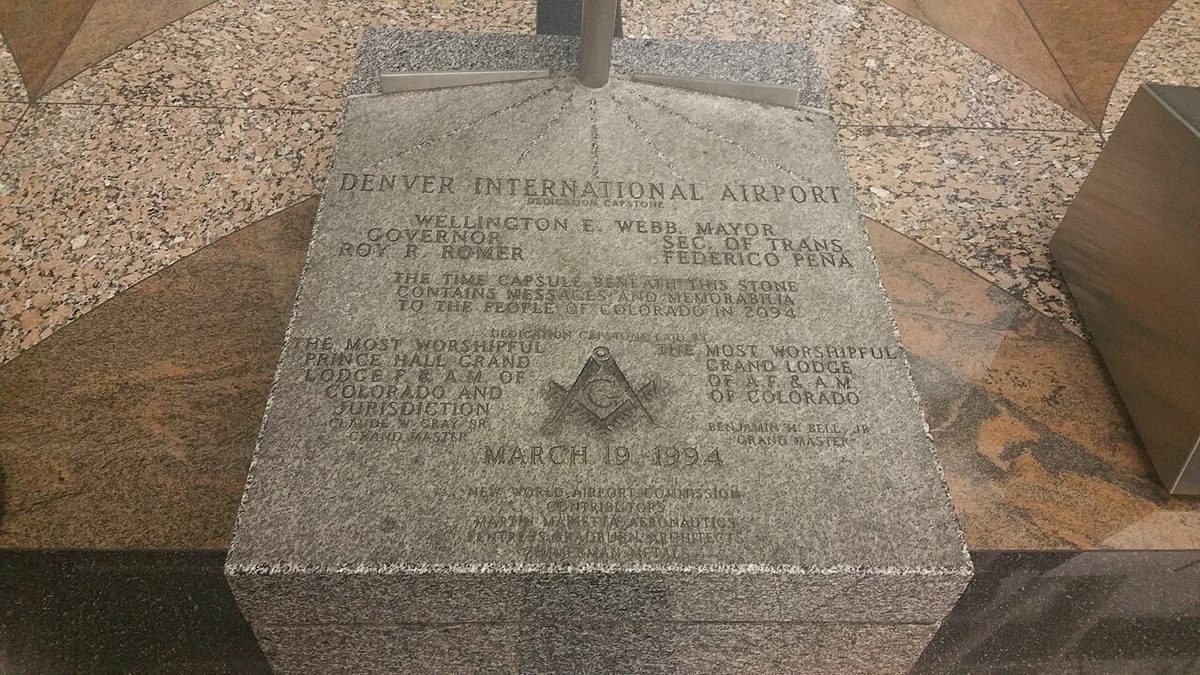
The time capsule has attracted its own rumors. Some claim it contains secret instructions for a future world government, while others believe a nearby Braille panel hides a keypad. Its reported contents are far less dramatic: coins, a Colorado Rockies baseball, casino tokens, and even a pair of former Denver Mayor Wellington Webb’s sneakers.
But the most intriguing detail might be the New World Airport Commission.
For years, conspiracy websites insisted the organization never existed, suggesting its name revealed a secret group controlling or financing the airport.
Except the commission was real.
According to Denver Public Library, symphony conductor Charles Ansbacher formed the temporary organization to help organize celebrations for the airport’s opening. Its unusual name came from Antonín Dvořák’s famous New World Symphony.
And there’s documentation to back it up. Denver Public Library holds 11 boxes of the commission’s records, including correspondence, meeting minutes, photographs, and promotional materials.
That’s quite a paper trail for a supposedly imaginary secret society.
The stone, its Masonic symbols, and the time capsule are all real. But the evidence points to a public dedication ceremony and an opening celebration, not a hidden organization plotting global domination.
The mystery of the New World Airport Commission leads to a symphony conductor, not the Illuminati.
6. Do Denver Airport’s Runways Really Form a Swastika?
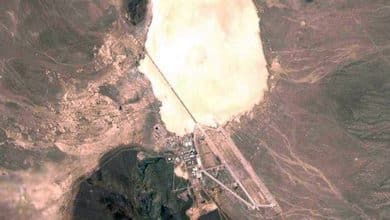
Look at Denver International Airport from above, and you’ll notice something unusual about its runways. Rather than forming a simple grid, they spread out around the terminal in a pattern resembling a giant pinwheel.
Some people see something much more disturbing: a swastika.
The resemblance has fueled claims that the airport was deliberately designed with Nazi symbolism, supposedly revealing a connection to a secret organization or the New World Order.
But there’s a problem with that theory. To make the runways form a swastika, you have to focus on certain lines while ignoring others. When you look at the complete layout, the supposed symbol becomes much harder to recognize.
And there’s a practical reason for the unusual arrangement.
DIA has six runways, four running roughly north to south and two east to west. Their orientation helps pilots take off and land in different wind conditions, while the wide spacing lets multiple aircraft operate without interfering with one another.
That was a major improvement over Denver’s old Stapleton Airport, where closely spaced runways contributed to delays during bad weather.
The layout also leaves room for future expansion, one of the reasons Denver built such an enormous airport in the first place.
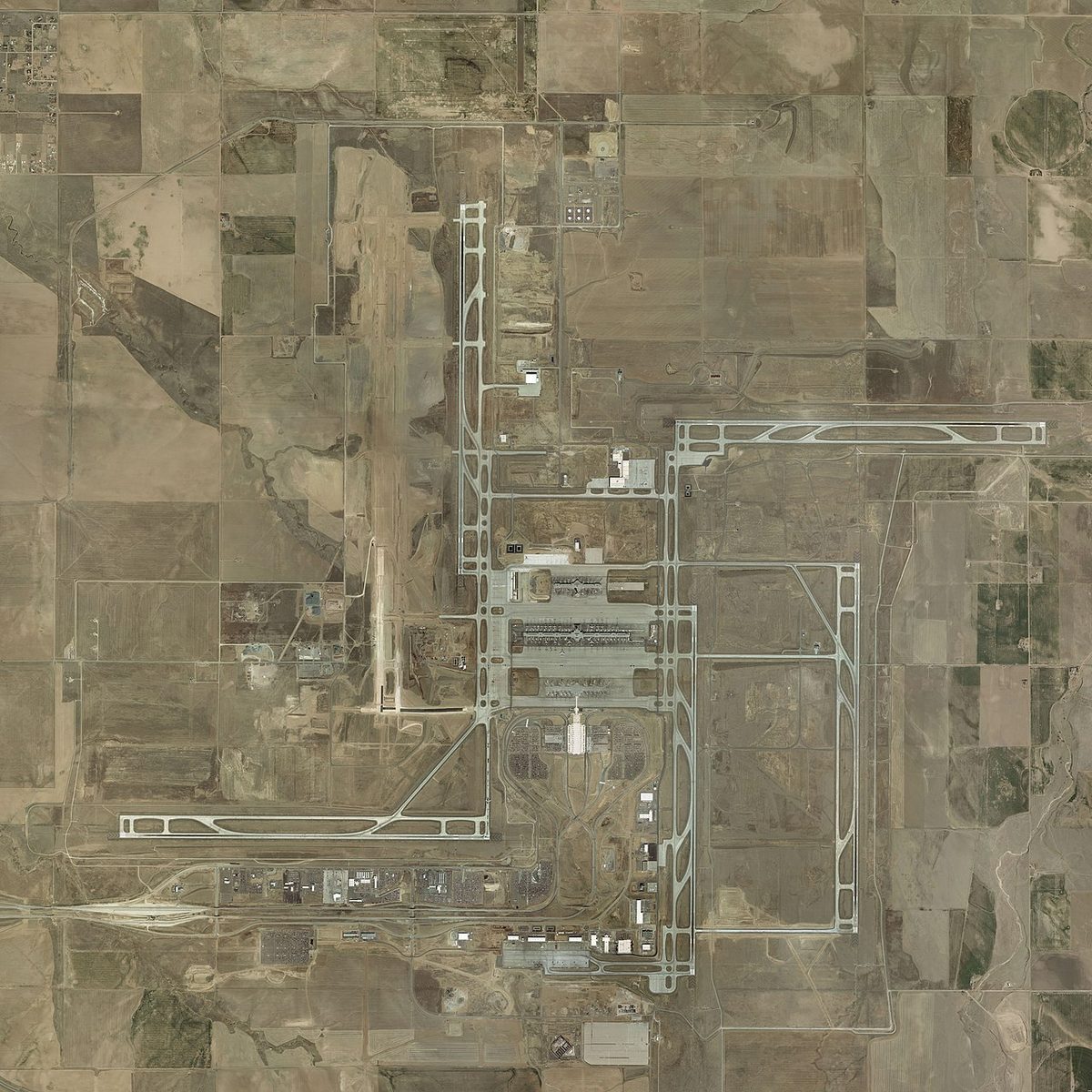
The runway pattern is real, but there’s no credible evidence it was designed to resemble a Nazi symbol. Aviation requirements provide a much more convincing explanation.
Still, this is one conspiracy theory worth examining for yourself. An aerial photograph tells the story better than any elaborate diagram connecting selected lines.
7. The Gargoyles and Strange Symbols Hidden in Plain Sight
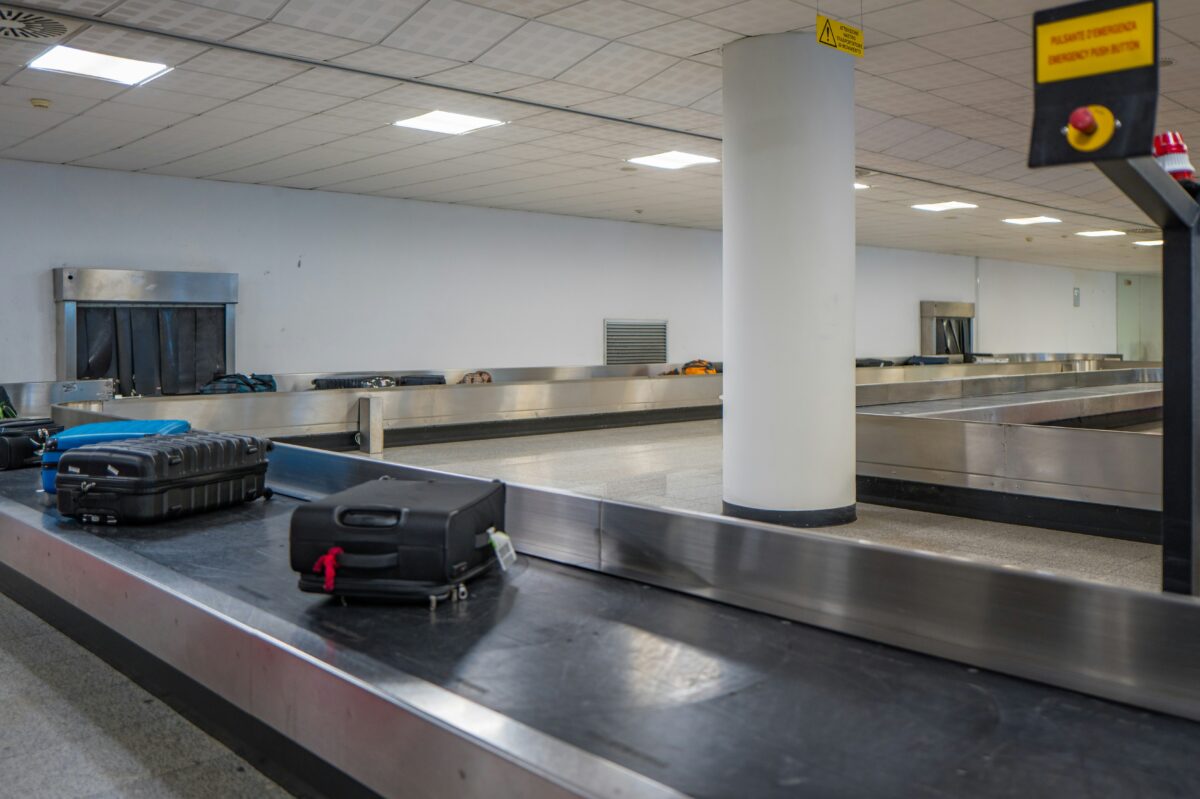
If you’ve ever waited for your luggage at Denver International Airport, you may have been watched by a gargoyle.
Two bronze creatures with horns, pointed ears, and mischievous expressions sit inside open suitcases above the east and west baggage claim areas. They’re part of Notre Denver, a public art installation by artist Terry Allen.
One of the gargoyles looks particularly unsettling, with its horned head resting in its hands as it crouches inside an open suitcase. Some have described it as a suitcase demon, although the artist intended it as a playful guardian of travelers’ luggage.
Gargoyles have guarded churches and other buildings for centuries, traditionally serving as symbols of protection. DIA’s versions have a much more specific job: making sure your luggage arrives safely.
Even the suitcases have a local connection. They’re Samsonite bags, a nod to the company’s former Denver manufacturing plant.
Of course, not everyone sees the gargoyles as friendly baggage guardians. Their appearance has inspired speculation about demons, occult symbolism, and the airport’s supposed connections to secret societies.
And they’re not the only unusual details hiding in plain sight.
Embedded in the terminal’s terrazzo floor is an image of a mining cart bearing the letters Au Ag. Some conspiracy theorists interpreted those letters as a reference to the Australia antigen, a marker associated with hepatitis B, and claimed the inscription hinted at a secret biological weapon.
The actual meaning is considerably less alarming. Au and Ag are the chemical symbols for gold and silver, referencing Colorado’s mining history. The mining cart is a pretty big clue.
Neither the gargoyles nor the floor markings provide evidence of a sinister plot. They’re pieces of public art that reflect local history, tradition, and a little artistic humor.
And considering how many travelers have lost luggage at DIA over the years, a couple of gargoyles assigned to protect the baggage might not be such a bad idea.
8. Is There Really a Secret Bunker Beneath Denver Airport?
One of the strangest claims about Denver International Airport is that construction crews completed five enormous buildings, realized they were in the wrong locations, and buried them instead of tearing them down.
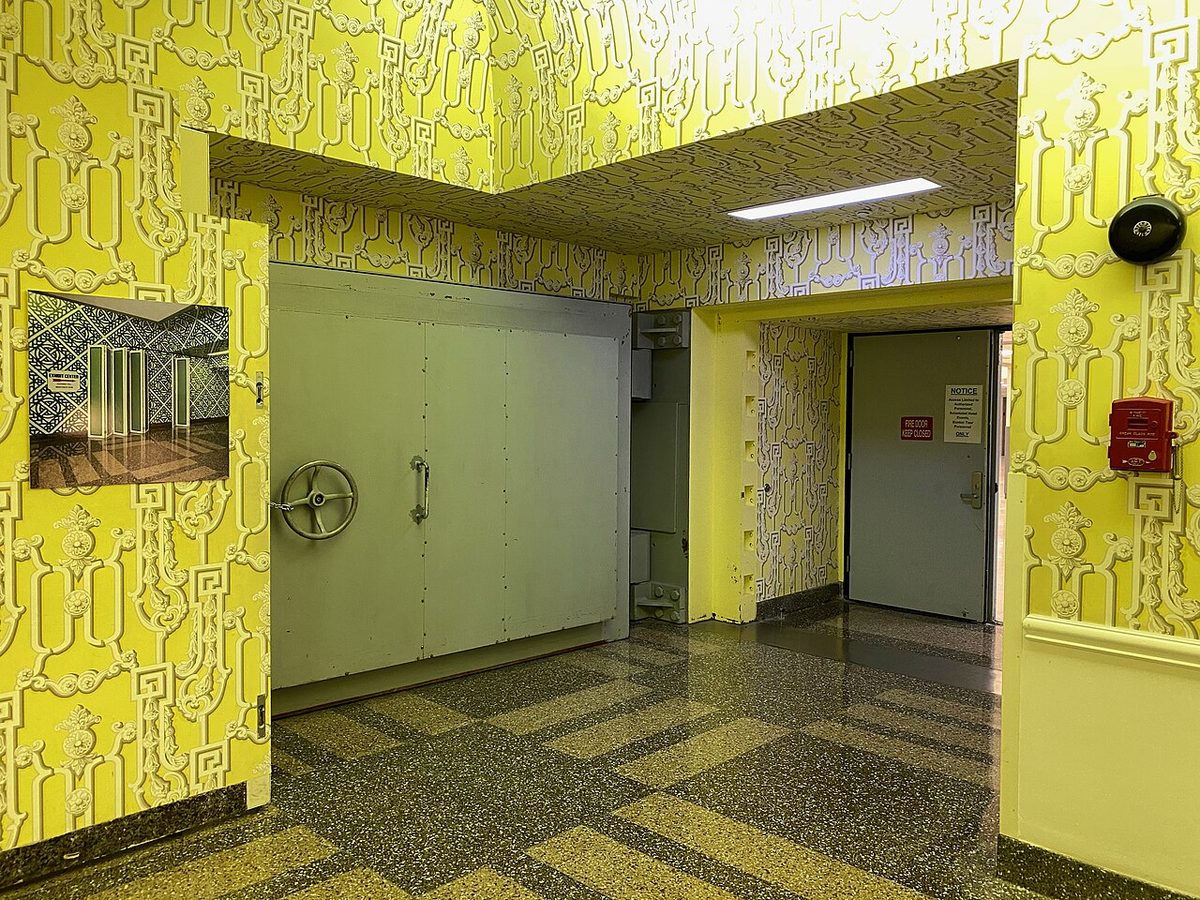
According to the story, those buildings still exist beneath the airport, connected by tunnels and converted into a secret underground complex. Some versions even claim blueprints exist showing the buried structures.
No authenticated blueprints, construction records, or other credible evidence have surfaced to establish that the five buildings exist.
Some conspiracy theorists believe DIA contains a multilevel bunker designed to shelter government officials and wealthy elites during a nuclear attack or global catastrophe. Others claim there’s a secret military installation beneath the runways, connected by a tunnel to NORAD’s Cheyenne Mountain complex near Colorado Springs.
The stories gained traction during the 1990s, when the airport’s troubled construction and extensive underground infrastructure were already attracting suspicion.
A 2007 Westword investigation traced much of DIA’s early conspiracy mythology to author Alex Christopher, whose claims about the airport spread following a 1996 radio interview. Other conspiracy promoters, including Phil Schneider, added stories about secret military bases and sprawling underground facilities.
But one detail makes the bunker theory particularly interesting: the U.S. government really has built secret shelters beneath seemingly ordinary places.
During the Cold War, a massive underground bunker was constructed beneath the Greenbrier resort in West Virginia. Designed to shelter members of Congress during a nuclear attack, it remained secret until its existence was publicly exposed in 1992. Today, visitors can tour the former facility.
That history helps explain why some people find the DIA story believable. Secret government bunkers aren’t purely fictional.
But the existence of a documented bunker in West Virginia doesn’t establish that another one was built beneath Denver’s airport.
DIA’s real tunnels have been photographed, toured by reporters, and explained by airport officials. Denver Public Library has also investigated the underground-city claims and found no evidence supporting the alleged multilevel complex.
And while restricted areas naturally invite speculation, airports have plenty of legitimate reasons to keep passengers away from baggage machinery, maintenance equipment, and operational infrastructure.
The five buried buildings remain one of DIA’s most persistent mysteries, but only as an unverified story. Decades after the rumor began circulating, nobody has produced credible evidence showing that those buildings were ever constructed.
9. Why Was an Egyptian God of Death Standing Outside Denver Airport?
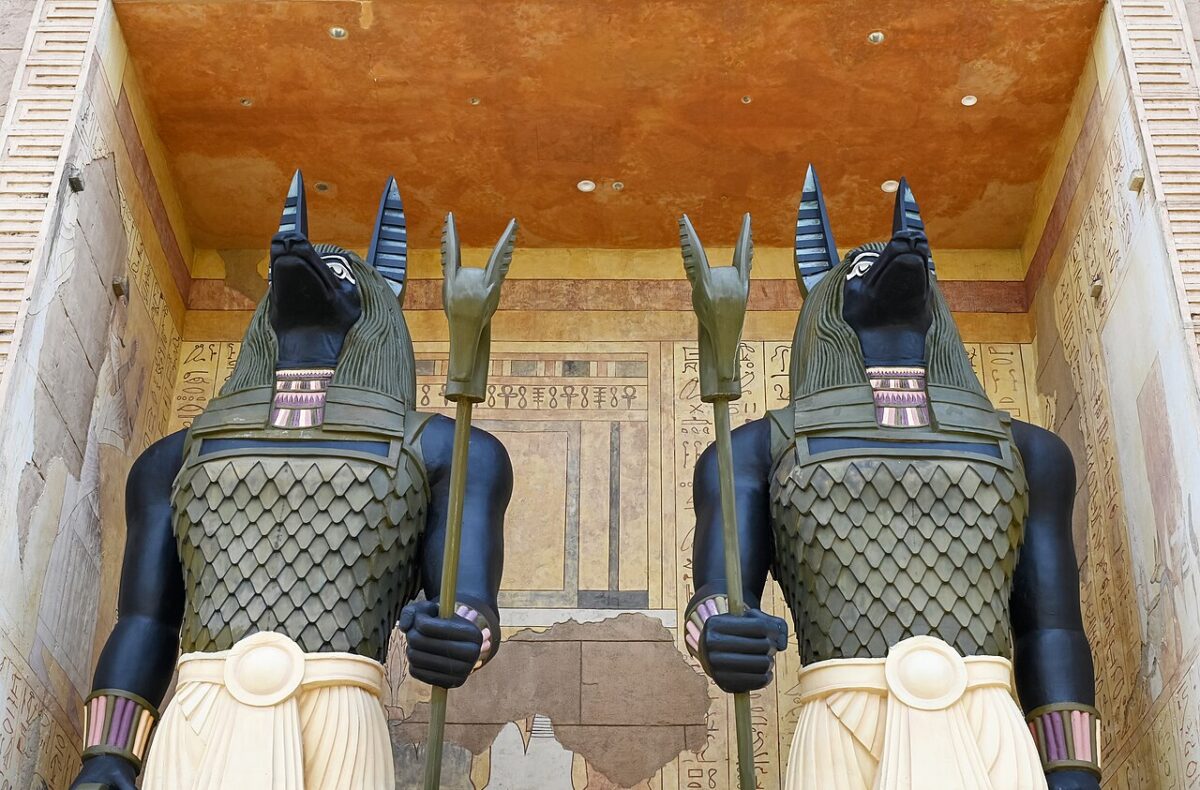
As if a giant blue horse with glowing red eyes wasn’t enough, Denver International Airport once welcomed travelers with a towering statue of Anubis, the ancient Egyptian god associated with death and the afterlife.
And this wasn’t some obscure decoration tucked away in a corner. The towering jackal-headed figure stood outside the main terminal, reaching approximately 26 feet into the air.
The statue appeared in June 2010, and conspiracy theorists quickly connected it to the airport’s already mysterious reputation. Why would an airport surrounded by rumors of secret societies and underground bunkers display a giant Egyptian deity associated with the dead?
Some interpreted the statue as another symbol of the airport’s supposed involvement in occult rituals or plans for a global catastrophe.
But the explanation had nothing to do with secret societies.
The statue was a temporary promotional display for Tutankhamun: The Golden King and the Great Pharaohs, a traveling exhibition at the Denver Art Museum.
It was installed to attract attention to the museum’s King Tut exhibition, which ran from June 2010 into January 2011. The statue was privately funded and eventually removed.
Yet photographs continued circulating online, often without mentioning that the statue was temporary or explaining why it was there.
That’s what makes this particular story so revealing. The giant Egyptian statue was real, but the sinister meaning attached to it came entirely from speculation.
For an airport already famous for apocalyptic murals, Masonic symbols, and Blucifer, even a museum advertisement became another piece of supposed evidence.
10. Denver Airport Put Lizard People on Its Construction Signs
Most airports would probably prefer that travelers stop talking about secret bunkers, alien visitors, and underground civilizations. Denver International Airport decided to have some fun with the rumors instead.
In 2018, as the massive Great Hall renovation got underway, DIA covered its temporary construction walls with something far more entertaining than the usual apologies for dust and noise.
There were images of aliens, lizard people wearing hard hats, and mysterious symbols. One sign asked whether workers were building an Illuminati headquarters, remodeling the lizard people’s lair, or simply adding new restaurants.
Another apologized for the mess caused by building secret underground tunnels.
The signs were part of a campaign called #DENFILES, a playful nod to The X-Files. They encouraged travelers to explore the airport’s infamous conspiracy theories while promoting the renovation happening behind the walls.
But DIA had already been having fun with its reputation for years.
In October 2016, the airport declared an entire month devoted to conspiracy theories. It opened a temporary exhibit called Conspiracy Theories Uncovered, organized public tours exploring the strange artwork, and hosted a costume party and screening of Close Encounters of the Third Kind.
There was even a Facebook contest offering a behind-the-scenes tour of the airport’s underground facilities. The official announcement joked that the winner would need to pass a background check and take an oath of eternal secrecy.
Then, for the airport’s 24th birthday in 2019, DIA introduced Greg, a talking animatronic gargoyle that surprised passing travelers with jokes about the airport’s alleged secrets.
And the airport didn’t stop there.
In April 2019, DIA officially became a sister airport to Roswell International Air Center in New Mexico, a city famous for its own alien and UFO legends. The announcement even joked about the airports sharing plans for dealing with extraterrestrials.
As recently as December 2024, DIA opened an alien-themed children’s play area on Concourse C, another nod to its unusual reputation.
What started as decades of rumors had become a recognizable part of the airport’s identity. Rather than trying to make people forget the conspiracy theories, DIA found ways to turn them into entertainment.
Of course, not everyone appreciated the jokes. Some conspiracy believers interpreted the airport’s playful signs as further proof that officials were hiding something in plain sight. Airport leaders have also since stepped away from making light of theories connected to harmful stereotypes.
Still, there’s something wonderfully strange about an airport that responds to rumors of underground lizard people by putting them on its construction signs.
DIA didn’t create its bizarre reputation. But it certainly learned how to make the most of it.
The Wildest Denver Airport Conspiracy Theories
Secret bunkers and a cursed blue horse are just the beginning. Some Denver airport conspiracy theories get so bizarre they sound like rejected science fiction plots. And a few have surprisingly interesting origins.
- Secret tunnels transport dead government dissidents. One grim theory claims DIA has underground passages for transporting bodies to NORAD near Colorado Springs. Former airport security official Jeff Price offered a possible explanation: workers nicknamed oversized baggage carousels “coffins.” Radio chatter about problems near the coffins may have helped turn an ordinary baggage-handling term into a sinister story.
- An airport mural predicted the COVID-19 pandemic. In 2020, an image showing children wearing face masks circulated online, with claims that DIA had displayed the painting since 1994. Some saw it as evidence that powerful people knew a pandemic was coming. But the painting, Maskcommunication, was created by Filipino artist Christian Joy Trinidad in 2020. It was never part of DIA’s art collection.
- Secret runways are buried underground. Some theorists claim enormous runways stretching four or five miles lie hidden beneath DIA, ready for powerful elites to uncover and use during a global catastrophe. Nobody has produced credible evidence that these runways exist.
- A 1977 alien movie predicted DIA’s location. Some believe Steven Spielberg’s Close Encounters of the Third Kind revealed the airport’s future location years before construction began. The supposed clue? Coordinates mentioned in the film. But those coordinates point to a location north of DIA, not the airport itself.
- The airport will become a massive detention camp. One particularly disturbing theory claims the underground facilities aren’t shelters for the wealthy at all. Instead, they’re supposedly part of a future prison complex where a New World Order would detain people who resist its control. No credible evidence supports the claim.
These stories show how far DIA’s mythology has traveled. A misunderstood radio message becomes a secret morgue. An unrelated painting becomes proof of a planned pandemic. A movie reference becomes evidence of an alien connection.
The fascination with impending catastrophe extends well beyond Denver. Similar fears helped fuel the widespread belief that the world would end on December 21, 2012, a prediction rooted in misunderstandings about the Maya calendar.
The stories are entertaining, but there’s a big difference between finding a strange coincidence and finding evidence of a conspiracy.
Denver Airport Conspiracies: Fact vs. Fiction
The strange details behind Denver International Airport’s conspiracy theories are often real. It’s the explanations people attach to them that get questionable. Here’s how some of DIA’s biggest mysteries hold up against the evidence.
| The Claim | What the Evidence Shows |
|---|---|
| Secret underground bunkers house powerful elites. | DIA has extensive tunnels for trains, baggage, and airport operations. There’s no credible evidence of a hidden doomsday complex. |
| Five completed buildings were buried beneath the airport. | No authenticated blueprints, construction records, or reliable evidence have surfaced to support this story. |
| Billions in construction overruns funded secret facilities. | The delays and cost overruns were real. Investigations documented serious baggage-system failures and financial problems, not secret construction. |
| The New World Airport Commission was a secret organization. | The commission was real and helped organize opening celebrations. Denver Public Library holds 11 boxes of its records. |
| Masonic symbols reveal who secretly controls DIA. | Freemasons participated in the public dedication ceremony. The stone and its 2094 time capsule are real, but secret control is unsupported. |
| The murals predict war, genocide, and environmental catastrophe. | The disturbing imagery is real. Artist Leo Tanguma created the murals to condemn violence and environmental destruction, not celebrate them. |
| Blucifer is cursed. | Sculptor Luis Jiménez died in an accident while creating the horse. The tragedy is documented; claims of a supernatural curse aren’t supported. |
| The runways were deliberately arranged into a swastika. | The layout can suggest that shape when viewed selectively, but runway orientation and spacing have practical aviation purposes. There’s no evidence of deliberate Nazi symbolism. |
| The Au Ag markings refer to a biological weapon. | Au and Ag are the chemical symbols for gold and silver, reflecting Colorado’s mining history. |
| The Anubis statue and lizard-people signs reveal occult connections. | The Anubis statue promoted a King Tut museum exhibition. The conspiracy-themed construction signs were part of DIA’s playful marketing campaigns. |
| The time capsule contains secret New World Order instructions. | The capsule is real and intended to be opened in 2094. It reportedly contains memorabilia, including coins, a baseball, and a former Denver mayor’s sneakers. There’s no evidence of secret instructions. |
The airport’s history is unusual enough without adding secret societies or underground cities. And some of its best stories, from Blucifer’s tragic creation to the spectacular failure of its baggage system, are completely documented.
The Real Mystery Is Why the Stories Persist
I’ve watched DIA change over the years, from the airport I remember before the major renovations to the one travelers see today. The artwork has moved, construction walls have come and gone, and the terminal looks different. But the rumors? Those haven’t gone anywhere.
Maybe that’s because DIA gives people so much to work with. The underground tunnels are real. The artwork is unusual. The construction problems were enormous. And some of the strangest stories have perfectly ordinary explanations that are still fascinating.
What’s more interesting to me isn’t the possibility of a secret underground city. It’s how a collection of real events, unusual decisions, and misunderstood details turned an airport into a legend.
After all these years, DIA still has plenty of mysteries to talk about. Most of them don’t require a conspiracy.
Have you spotted something strange at DIA or heard a rumor we missed? Share your experience in the comments.
More Mysteries Worth Exploring
Denver’s airport isn’t the only place where strange facts have inspired even stranger stories. Nevada’s infamous Area 51 has its own fascinating history of secret government projects, unusual aircraft, and alien rumors. Discover 13 Area 51 facts that sound made up but are actually true.
If strange landmarks and unexplained stories are your thing, explore the 10 most haunted places in America, where eerie histories, ghostly encounters, and local legends have kept people talking for generations.
And for mysteries that still don’t have clear answers, explore 15 mysterious disappearances that still don’t add up, including cases where the evidence raises as many questions as it answers.
Love a good mystery or a story that makes you think twice? Visit our Beacon & Burrow community for fascinating stories, fresh perspectives, and conversations worth having.





Now i only have one thing to say, i feel as if they want to have conspiracies to be spread about the airport. Is it just me or is it like they do it on porpouse to make people think such things? Or maybe they are hiding in plain sight? I don’t know but one thing is sure, all the weird things about this airport really makes you question it.
I think you should either delete this page, or update it when people bring facts to your attention, or more information.
1) The Elenin comet missed the Earth by 22 Million miles not 22 Miles.
2) Many sources claim that Obama was not in Denver that day, or even that month. I don’t know of a credible source that would confirm where he was, so I won’t tell you that it is so.
3) DIA is one of the busiest airports in the world, as you noted, it is also the largest in the US. WIKI: “By the 1980s, plans were under way to replace Stapleton with a new airport. Stapleton was plagued with a number of problems, including: * inadequate separation between runways, leading to extremely long waits in bad weather * little or no room for other airlines that proposed/wanted to use Stapleton for new destinations (an example of this was Southwest Airlines) * a lawsuit over aircraft noise, brought by residents of the nearby Park Hill community * legal threats by Adams County, Colorado, to block a runway extension into Rocky Mountain Arsenal lands” You ask the question was it necessary, but your own article states facts that suggest it was, and thirty seconds on WIKI helps too.
4) You talk about the absence of information on New World Order Commission. Why don’t you include the statement by Steve Snyder, head of PR at DIA? Here it is: “The New World Airport Commission was simply a group consisting of local business and political leaders who sponsored and organized a number of pre-opening events at Denver International Airport. The airport was to usher in a new era making Denver a world-class city, thus the New World name. The group has absolutely no association with the new world order.” The contributors are THE NAMES BELOW the words “New World Airport Commission”. Not very difficult to understand.
5) If you can’t show an unbiased presentation of information, provide links like the ones above to show the other side of the arguments, otherwise you are deluding yourself and others for the cheap thrill of believing in a mystery.
6) I’m not saying it isn’t possible, I’m not saying that it is implausible, but do other people really have to do the research for you? Or were you aware of the facts, and simply included what you thought sounded most interesting?
7) I imagine most of the people interested in this conspiracy theory are Americans. Wouldn’t it be really really really stupid to point out to the world that your own government may have bunkers to protect some of it’s citizens, or have your allegiances simply faded to the point where if a bunker isn’t for you, it shouldn’t be for anyone? In the event of nuclear war, would it be best for your nation to all go down together holding hands, or should there be hidden facilities to protect ‘American culture’, as oxymoronic as that may sound. I’m sure there is a bunker jam packed with Yankees hats and long life hot dogs somewhere in the Rockies, maybe this is what DIA is hiding.
The page is called Exploring Life’s Mysteries, and yet you don’t explore them, do you? I wouldn’t even call my rebuttal an exploration of this ‘mystery’, simply a little bit of online sourced information, with questionable sources.
Please consider what I’ve said, not as an affront to yourself, but an opportunity to consider in the future, not deluding yourself or others. Provide as much accurate information as possible, and when you can, offer the OTHER point of view, the links or ideas that may debunk the more romantic or exciting possibilities. Otherwise, it is just plain douchery.
Cheers buddy, OK guy
Yea because the bunkers are for everyone, not for the elite and rich. They are also for homeless and ebt LMFAO. You’re an idiot. If something goes down you will die along with 99 percent of us because we are not rich. You have to be stupid if you think the rich don’t have a plan for when disaster strikes. Don’t believe nothing but when the time comes I will be ready.
Thank you so much for your feedback and your concerns about reporting any possible false or inaccurate facts. We will be double checking and adding additional references in the coming weeks. We appreciate your time to help us ensure we providing the most knowledgeable, up to date and correct information to our readers as possible.
March 31 Update:
1) Comet Elenin was in fact 22 MILLION miles – or 21,730,000 miles to be exact, this has been updated.
2) According to Wikipedia Obama was in Washington DC on October 16, 2011 at the dedication ceremony for the Martin Luther King, Jr. Memorial, this has also been updated.
“He and his family were attending the dedication ceremony for the Martin Luther King, Jr.”
Please take out the “the” before Martin Luther King Jr, it bothers me so much.
Rhiannon, it’s fixed! Thanks for letting us know.
I have access to the secret base on the moon and they beam me up Scotty from Startrak. It exists in Alaska right now. Even a man made hyposonic alien built aircraft underground network of the United States military for special operations.
Hello my name is Matthew Ryan Silva. I live in Tampa Florida but my point is that my uncle has nuclear weapons launch codes and the hidden highly secret bunkers were made by my father. He was special operations forces for the United States of America. We already know that aliens exists in Denver Colorado airport and I have personally been inside area 51. I can take 5 people to the base to see one of the aircrafts.
I would have to see any of this to believe it and anybody that can prove it has my vote.
Having lived by the old airport (Stapleton) and using the airport to its final days, I know why it shut down and opened a new one. For years the people of Aurora and Denver complained of the noise that airplanes were making over their houses. I remember many hearings and law suits filed against the city of Denver for noise pollution. Latter on the citizens won a law suit against Denver. If I remember right the FAA would fine the city of Denver for noise levels. Each time a flight came from the east they would get fined! I can’t remember how much but i think it was allot of Money! So why did they buy so much land? Well when Stapleton was built there wasn’t very many houses their and the city of Aurora was just starting to become a place to move to, so what it was, a bunch of idiots building their houses next to a very busy airport! When they planed the new DIA they said that we will make sure no one can build next to it! very simple, learn from the law suits that can come in later years!
Now as far as the tunnels under the airport and leading to Colorado Springs to NORAD well their is no evidence of that either! I am a retired miner that worked at a local mine, I know what it would take to build a tunnel from DIA to Colorado Springs and their is no way they could have accomplished this task with out anyone knowing. it would take more then a 2 billion dollars to do it! also how do you hide billions of tons of rock? it took the mine I worked at 30 years to mine 1 billion tons of rock.
Have you not heard of nuclear fusion underground tunnel machine patented in 1972.
What a bunch of B.S. This is, in it’s entirety, laughable. Please list the multiple sources you cite when addressing the non-existence of the New World Airport Commission. There is nothing you mention here that can be substantiated by fact. It is nothing more than supposition and hyperbole. Do people really believe this sort of thing?
All I have to say, is BIG HAIRY BALLS HANGING OFF A DOG!
Actually the AUAG symbol is not displayed directly in front of the mural. If you don’t get the little details right how are we supposed to believe the rest of your argument?
Saw this site and article on America Declassified last night on the Travel Channel. Awesome show and your article covers it well too. So cool! Love your logo too.
I am flying into the Denver airport this Friday for the holidays and had no clue that there were conspiracies around it. I hope that between this and the end of the world on 12/21 (this Friday) I don’t spontaneously combust. Is there anyone else out there traveling to Denver on December 21st and if so, let’s meet up at the airport bar and celebrate the end of the world!
Gonna let u know right now the world didnt end